2026 Digital Decade Report: digitalization is advancing, but digital skills remain the unresolved bottleneck for SMEs
June 2026 — The State of the Digital Decade 2026 data has been published, the European Commission’s annual report monitoring Member States’ progress toward the digital transformation targets set for 2030. The picture that emerges is mixed: Europe is advancing on connectivity, digital public services, and technology adoption, but the critical bottleneck remains unchanged — SMEs continue to struggle with a lack of digital skills and to delay the integration of data analytics and AI solutions for a strategic digitalization of their business models.

The European landscape
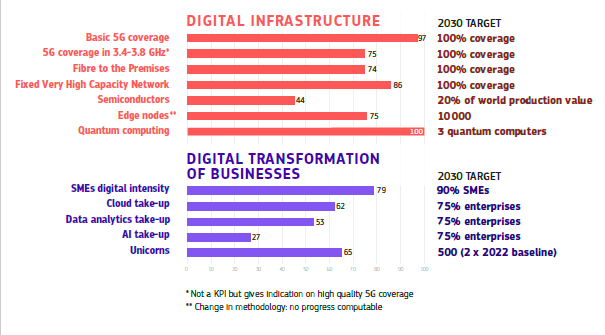
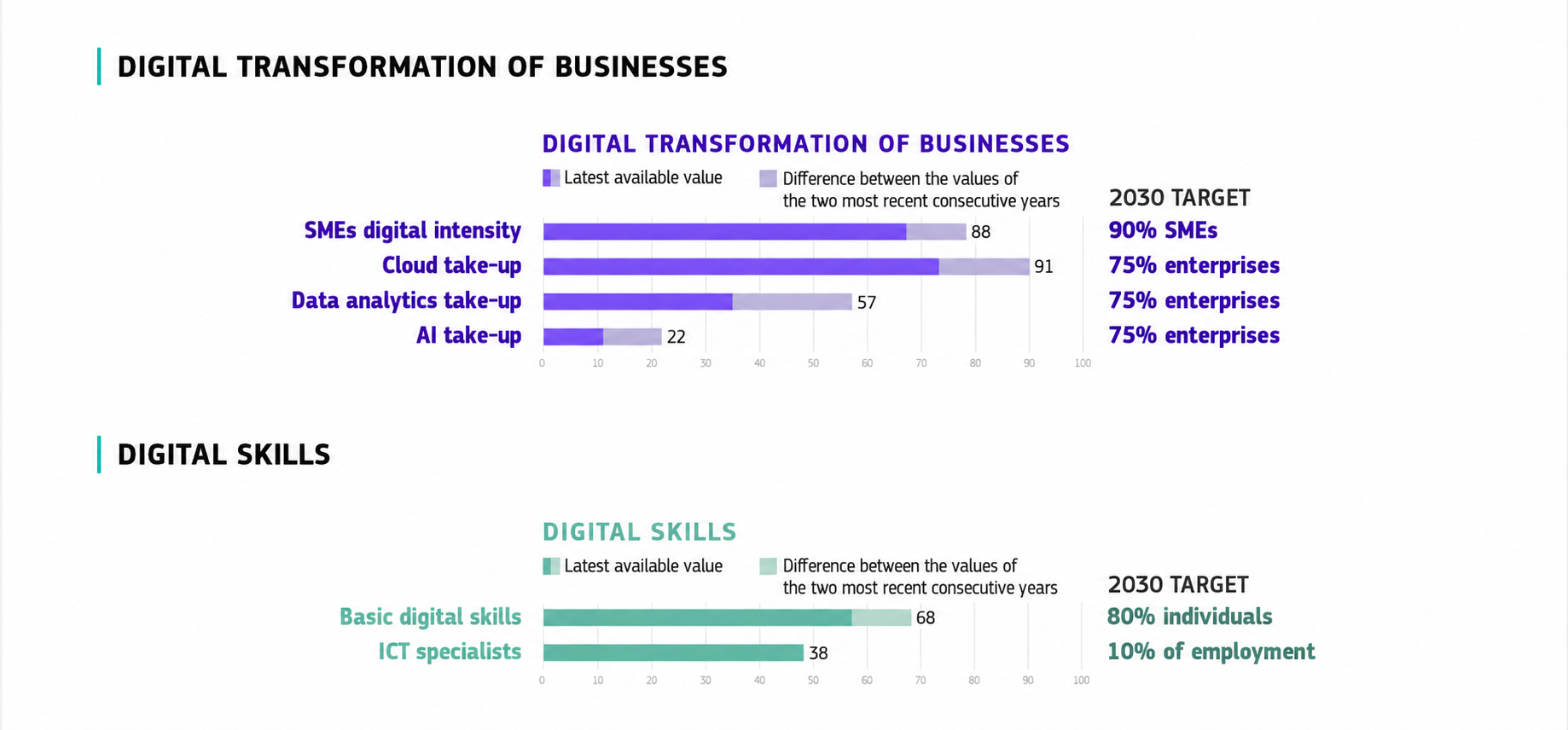
The report records progress on multiple fronts: 5G coverage has reached 96.8% of European households, 46.7% of businesses use cloud, 39.9% use data analytics, and nearly 20% use AI — with adoption of the latter growing 48% over the past year. For the first time, over 60% of Europeans have at least basic digital skills.
Structural gaps remain, however. ICT specialists still account for only 5% of total employment — half the 2030 target — with women representing less than 20% of the total. On technological sovereignty, Europe covers only 9% of the global semiconductor market (target: 20%) and maintains significant dependencies on non-EU providers in cloud and cybersecurity. SMEs remain held back by three recurring obstacles: skills shortages, limited access to infrastructure, and insufficient resources.
Italy: 92% of targets on track
Italy monitors its progress with great accuracy: 92% of national targets are considered on track with respect to the Digital Decade national roadmap trajectories, with an allocated public budget of €33.95 billion.
Connectivity. Italy is above the European average on both FTTP (77.56% vs. 74.13% EU) and 5G (99.82% vs. 96.79% EU). A gap persists in rural areas for fiber (44.48%, compared to the European 62.61%), and the country does not yet have standalone (SA) 5G stations, against an EU average of 20.9%.
SMEs and technology adoption. 79.49% of Italian SMEs have reached at least a basic level of digital intensity, above the EU average (71.39%), with strong performance in cloud (68.05%) and data analytics (42.71%). The weak point is high intensity: only 7.34% of SMEs reach very high levels of digitalization (EU average: 9.07%). The technology is there, but 83% of SMEs report difficulties in adoption — skills shortages (59%), cultural barriers (44%), and costs (40%) being the main reasons.
Digital skills. 54.27% of the population has basic digital skills, with annual growth of 8.9% exceeding the EU average. However, gaps remain in education, gender, and age. On the ICT specialists front, the picture is more critical: at 3.8% of employment (below the EU average of 5%), with only 1.6% of ICT graduates and women accounting for 16.6% of specialists. For every new ICT professional entering the market, there are approximately two open positions.
Artificial intelligence. AI adoption in businesses has grown 100% in one year, but stands at 16.4% — below the EU average of 19.95%. Usage remains concentrated in non-strategic functions: text mining (70.8%), generative AI (59.1%), voice recognition (41.3%). Manufacturing, quality control, and predictive maintenance remain largely underutilized. The report recommends accelerating the operationalization of the AI framework (Law 132/2025), supporting adoption among SMEs, and strengthening centers of excellence with strong industrial ties.
Why continue to invest
The report addresses the issue of funding continuity with clarity. The data speaks for itself: every euro invested in digital measures through the RRF generates €1.50 of economic output at the EU level and €2.00 at the global level by 2030. For Italy, the digital component of the PNRR has generated an estimated economic impact of €56.7 billion against €46.8 billion invested.
The problem is that nearly half of the public funds included in national roadmaps are set to run out by the end of 2026. For this reason, the Commission calls on Member States to ensure continuity of investment in advanced connectivity, semiconductors, cloud and data infrastructure, AI, quantum technologies, and cybersecurity — and to support SMEs in accessing skills, infrastructure, and innovation ecosystems, in line with the priorities of the next Multiannual Financial Framework.
Sources: European Commission, State of the Digital Decade 2026 — 2026 State of the Digital Decade package; Commission Staff Working Document — Digital Decade 2026 Country Report: Italy (SWD(2026) 155 final, Part 15/27).

