SPACS — Sustainable Process Automation for Composite Solutions
by Andrea Spinelli – Industry 5.0 BU Manager at Kode
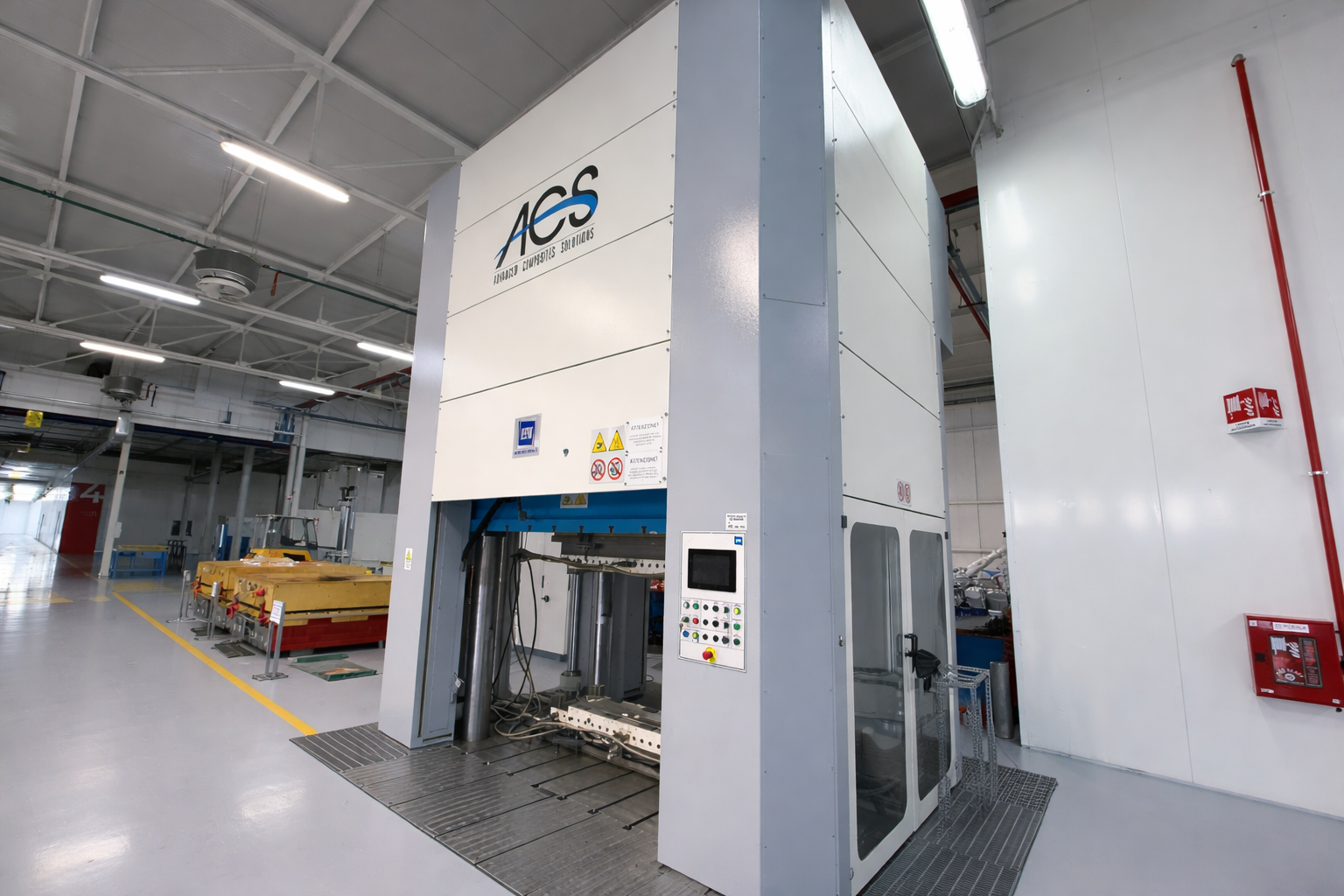
Production data integration, automated rescheduling and AI to optimise composite component manufacturing: the European project carried out by Kode with Advanced Composites Solutions (ACS), a leader in the design and manufacture of carbon fibre components for the automotive, aerospace, marine and industrial sectors.
When a carbon fibre component comes out of the autoclave and fails quality control, it is not just a part that needs reworking. Without automation, this event triggers a chain of manual interventions: the production manager must review the work schedule, assess the priorities of all active orders and manually find a slot for rework, all while production continues. In high-variability factories, where each work order has its own characteristics, this invisible cost quietly accumulates, order after order. SPACS was born out of this very practical challenge.
SPACS (Sustainable Process Automation for Composite Solutions) is an applied research project funded under the European Horizon programme through the greenSMEhub initiative. Kode partnered with Advanced Composites Solutions (ACS), a European and international leader in the design and manufacture of carbon fibre and other composite components for the automotive, aerospace, marine and industrial sectors. The goal: to bring data integration, intelligent automation and AI into manufacturing processes to enhance sustainability and competitiveness.
The challenge: fragmented data and manual scheduling
ACS’s manufacturing process comprises six main stages, from fibre cutting and nesting to autoclave curing and intermediate and final quality checks, with two structural challenges. In terms of integration, quality data is recorded in Excel spreadsheets that are not connected to the ERP, with no standardised channel for reporting non-conformities. Operationally, when Quality Control declares a component non-conforming, the rework order is manually reinserted into the production schedule, creating priority conflicts with ongoing orders. The challenge was therefore twofold: to integrate information flows into a single connected platform and to automate the rescheduling of non-conforming orders while retaining control.
The approach: from process analysis to data integration
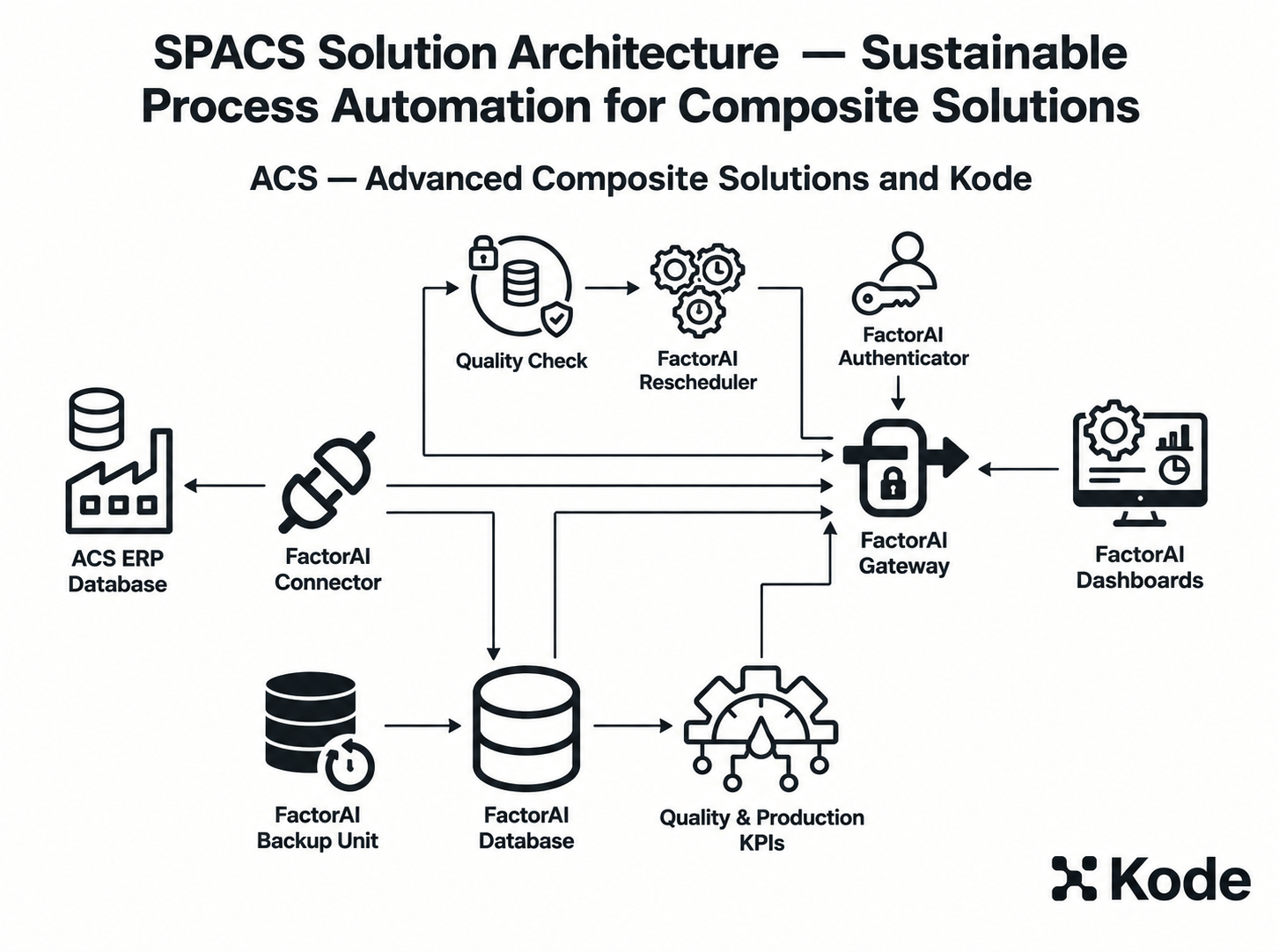
Kode began the project with an in-depth analysis phase: mapping the workflow for each work order (WO), identifying bottlenecks and defining the necessary integrations. The analysis identified four key processes to automate and resulted in an integrated IT platform based on FactorAI, Kode’s data science framework for Industry 4.0, connected to the company’s ERP through a custom-built connector.
By integrating around 50 variables from three sources (production progress data from the ERP, non-conformity causes and history from the quality system, and material availability and delivery constraints from planning), ACS gained access to a continuous flow of information spanning every level of the process. Procurement can thus monitor actual consumption against planned consumption, planning has real-time visibility of work centre loads, quality can track non-conformities by linking defects to specific production stages, and management has access to all key performance indicators (KPIs), automatically kept up to date.
The quality control platform
The solution’s first module is a web app dedicated to quality control. The platform enables QC operators to move away from Excel spreadsheets and record non-conformities using a taxonomy defined jointly with ACS technicians, linking them to the corresponding work order, eliminating transcription errors and making the information immediately actionable for planning. The module applies input validation rules that prevent ambiguous or inconsistent entries, ensuring consistency across departments. Over time, historical data feeds statistical analyses linking defects to production stages, work centres and material types, building the data foundation for predictive quality models.
Automated rescheduling: the heart of the system
The rework management and rescheduling module is the key element of the entire solution. It addresses a classic problem in high-variety discrete manufacturing: when an order is declared non-conforming and requires rework, reinserting it into the production plan means finding a scheduling slot that meets delivery deadlines and accommodates the rework without creating conflicts or cascading delays, while taking work centre loads, material availability and order type into account.
The solution implemented by Kode adopts automated rescheduling with human validation (human-in-the-loop): the prioritisation algorithm automatically calculates a proposal for reinserting the non-conforming order into the production schedule, considering the delivery date, order type and material availability without creating cascading conflicts.
The proposed plan is validated by the production manager before it becomes operational (human-in-the-loop): a deliberate choice, not a technical limitation, ensuring efficiency without taking control away from those responsible. The system also sends automatic real-time notifications to planning teams as soon as an order enters rework status.
Monitoring dashboards and KPIs
The fourth component is the visualisation and monitoring layer, which makes the data collected and processed by the underlying layers accessible in real time to different business functions. Two dashboards fed in real time by the three integrated sources provide a previously unavailable unified view: the Quality Control dashboard for operators, showing non-conformity status by work order, indicator trends and alerts; and the production KPI dashboard for management, aggregating key performance indicators on work centre efficiency, estimated versus actual time variances, and non-conformity volumes and types. Automatically correlating production and quality data makes it possible to identify recurring patterns and guide corrective action.
Results and outlook
SPACS is a completed experimental project: the results documented in the final report demonstrate that all predefined objectives were met or exceeded, with clear indications of the direction for potential future developments.
- Automated processes: 4, against an initial target of 1.
- Reduction in human error: 50%, thanks to the standardised reporting channel and the complete elimination of data entry in non-integrated spreadsheets.
- Energy savings: 20%, achieved indirectly by reducing rework and optimising production flows.
- Reduction in automatically detected defects: 15-20% in the final phase, with a target of 50% expected within 12 months of completion as the non-conformity database becomes more established.
- Employees involved and trained: 7-10, against a target of 5.
- Parameters monitored: 100, in line with the target.
- Processes integrated into the new IT solution: 4, against a target of 2.
The future developments identified by the project include completing integration with the autoclaves for direct energy monitoring and consolidating the non-conformity database as a foundation for predictive quality models: a step towards a system that not only detects defects but anticipates them.
Dynamic rescheduling: the technology and market landscape.
Recent literature recognises dynamic rescheduling in response to quality events as one of the most complex challenges in modern discrete manufacturing. The most advanced enterprise solutions support multiple rescheduling cycles per day, but target large companies with established IT infrastructure and substantial budgets. This level of sophistication is rarely accessible to manufacturing SMEs.
The solution developed by Kode for ACS does not implement complex combinatorial optimisation algorithms. Instead, it delivers a pragmatic, deployable solution that addresses the real problem, the disconnect between quality and scheduling, through an integrated architecture, a prioritisation algorithm based on practical operational rules and a human-in-the-loop design aligned with emerging Industry 5.0 best practices.
The project’s strength lies in its coverage of the entire information flow: from machine data to the ERP, and from quality control to planning, with automatic notifications and real-time dashboards. It is precisely this gap between quality systems and scheduling systems that researchers and industry practitioners identify as the main source of inefficiency in factories that have not yet completed the transition to Industry 4.0.
The solution’s most mature aspect is its governance model: automated rescheduling with human approval reflects design maturity, and the trust gradually built in the system is the prerequisite for every subsequent development.
“We were pleased to join the research project proposed by Kode,” commented engineer Roberto Catenaro, founder and CEO of ACS, “because it allowed us to test dynamic rescheduling tools to address the replanning needs arising from non-conforming products. In the future, we hope to permanently introduce digital scheduling and control tools to support series production and use AI to further optimise the entire production flow.”

