esynk: Production and energy, connected.
esynk connects your energy-consumption data with your industrial production data and turns it into action. It is not generic monitoring, but intelligence across your energy cycle, from generation and storage to consumption, and the optimisation opportunities it reveals.
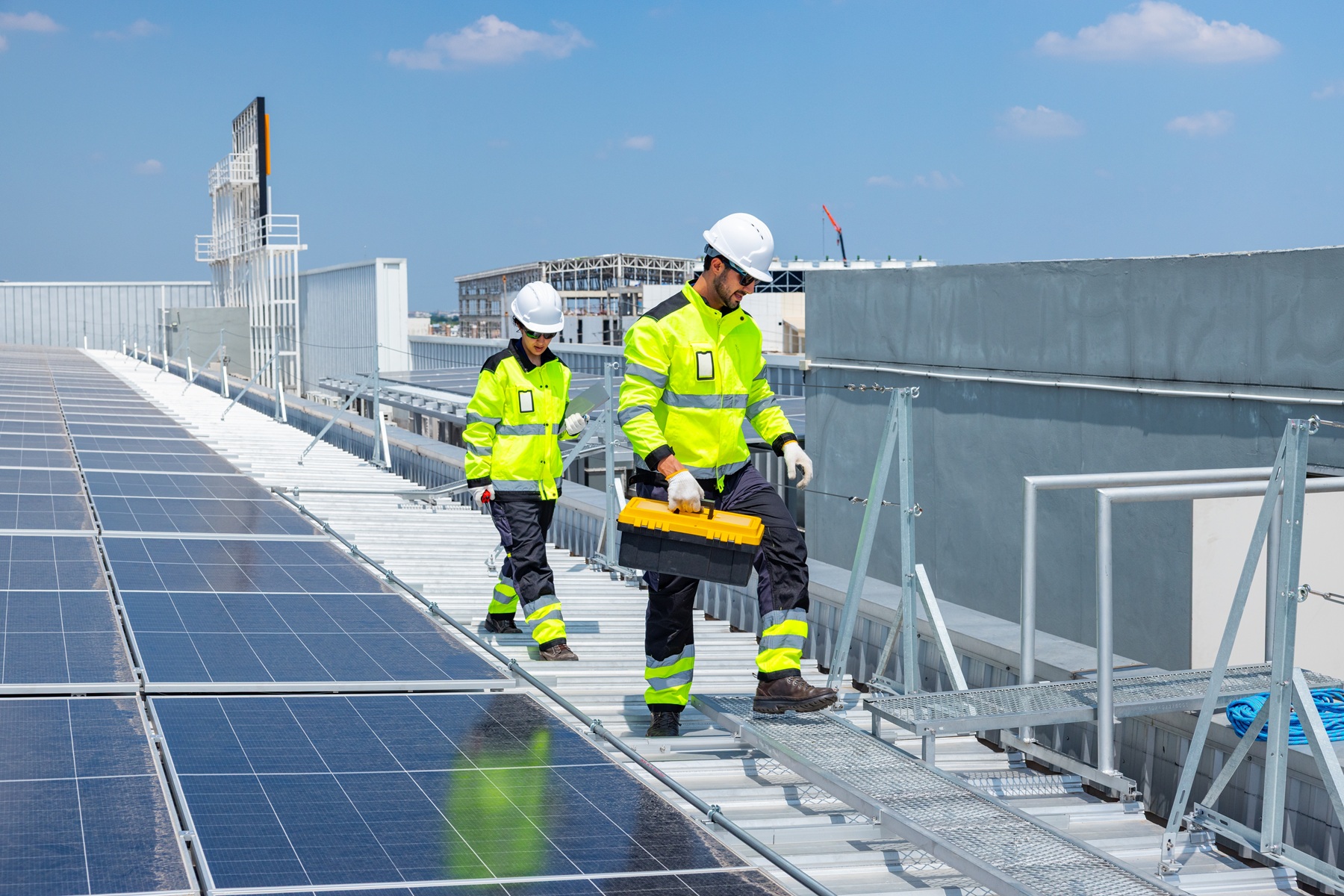
THE CONTEXT: Energy costs have increased.
Control hasn’t.
Manufacturing is the sector most affected by rising energy costs. Yet the typical response focuses only on the supply side—more solar panels, a better energy provider, storage—reducing the price per kWh without addressing consumption behaviour.
Energy data exists. Production data exists. The problem is that they do not communicate: no one knows how much energy each individual job costs, or when it truly makes sense to shift a production cycle.
A system is needed that can connect data from multiple sources and identify actionable solutions.
The approach.
Your energy consumption tells the story of your process. Starting with production data, we cross-reference it with energy flows to create a new layer of insight. esynk enables you to manage consumption peaks, contractual tariff periods, and renewable-energy availability to optimise your industrial processes and energy use.
01. Connect your data sources
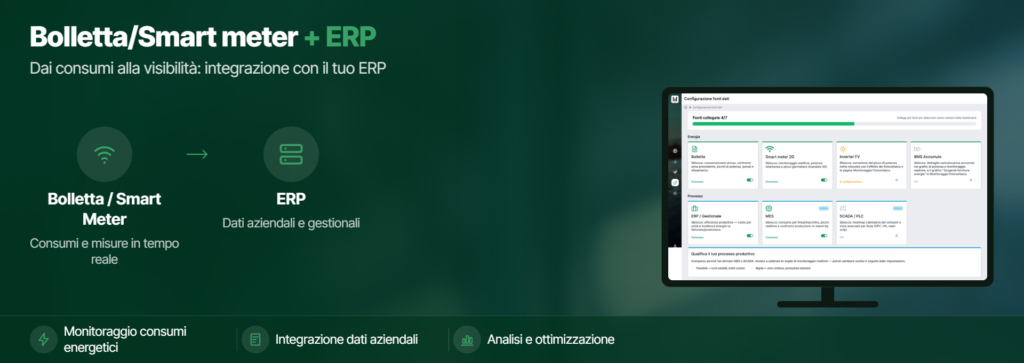
Energy bills, smart meters, PV inverters, ERP, MES and SCADA systems. Integration is gradual: you can start with the energy bill alone.
02. Put energy consumption into context
Every kWh is linked to a job order, a machine or a shift. Consumption stops being just a number and becomes actionable operational information.
03. Identify the levers for improvement
esynk can be integrated with anomaly-detection systems, peak-power and consumption forecasting, and optimisation tools for production planning, photovoltaic self-consumption and identifying shiftable loads. Only concrete, measurable levers.
04. Tangible benefits
- Identify which machines, lines or process stages have the greatest impact.
- Understand the causes of abnormal consumption.
- Optimise shifts, process or auxiliary loads, and production sequences.
- Measure the impact of decisions on energy consumption and costs.
- Forecast the output of your photovoltaic system to manage your energy consumption.
- Receive immediate alerts when your PV system’s performance declines.
The benefits
When energy and production speak the same language, every cost component becomes distinct and measurable, delivering tangible benefits:

Identify which machines, lines or process stages have the greatest impact.

Understand the causes of abnormal energy consumption.

Optimise shifts, process and auxiliary loads, and production sequences.

Measure the impact of decisions on energy consumption and costs.

Forecast the output of your photovoltaic system to manage your energy consumption.

Receive immediate alerts when your PV system’s performance declines.

Identify which machines, lines or process stages have the greatest impact.
THE SCENARIOS
Start with the data available today—even just the energy bill—and progressively add sources that enable increasingly precise answers.
Predictive consumption monitoring
Our predictive models analyse your consumption in detail: by time band, type of use, job order and machine. We anticipate future consumption by forecasting power peaks before they exceed the contractual threshold and identifying consumption patterns.
What you get:
- Energy-cost impact on revenue
- Guidance to avoid penalties or renegotiate your energy contract
- Identification of abnormal consumption
- Historical consumption trends and seasonality
Understand the drivers behind every cost
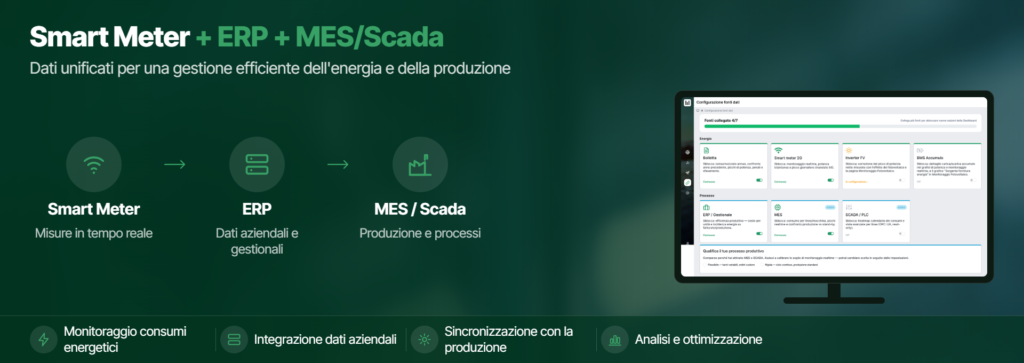
By combining granular meter data with the ERP order plan — and, where available, machine data from MES and SCADA — every kWh stops being an anonymous number and becomes an attributable cost: to a job order, a shift or a production line. This is the layer of insight that helps you understand which job orders are underpriced in terms of energy, where energy is wasted outside operating hours, and when power peaks become avoidable penalties.
What you get:
- Energy cost per job order / per product
- Recurring peaks with estimated monthly penalty in €
- 7–30-day consumption forecast
- Identification of the causes of energy anomalies in the context of the production plan
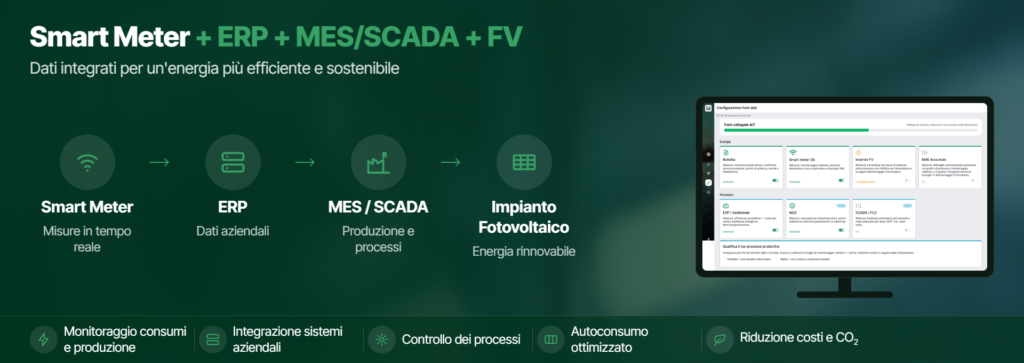
Produce when it costs less—and the other way around
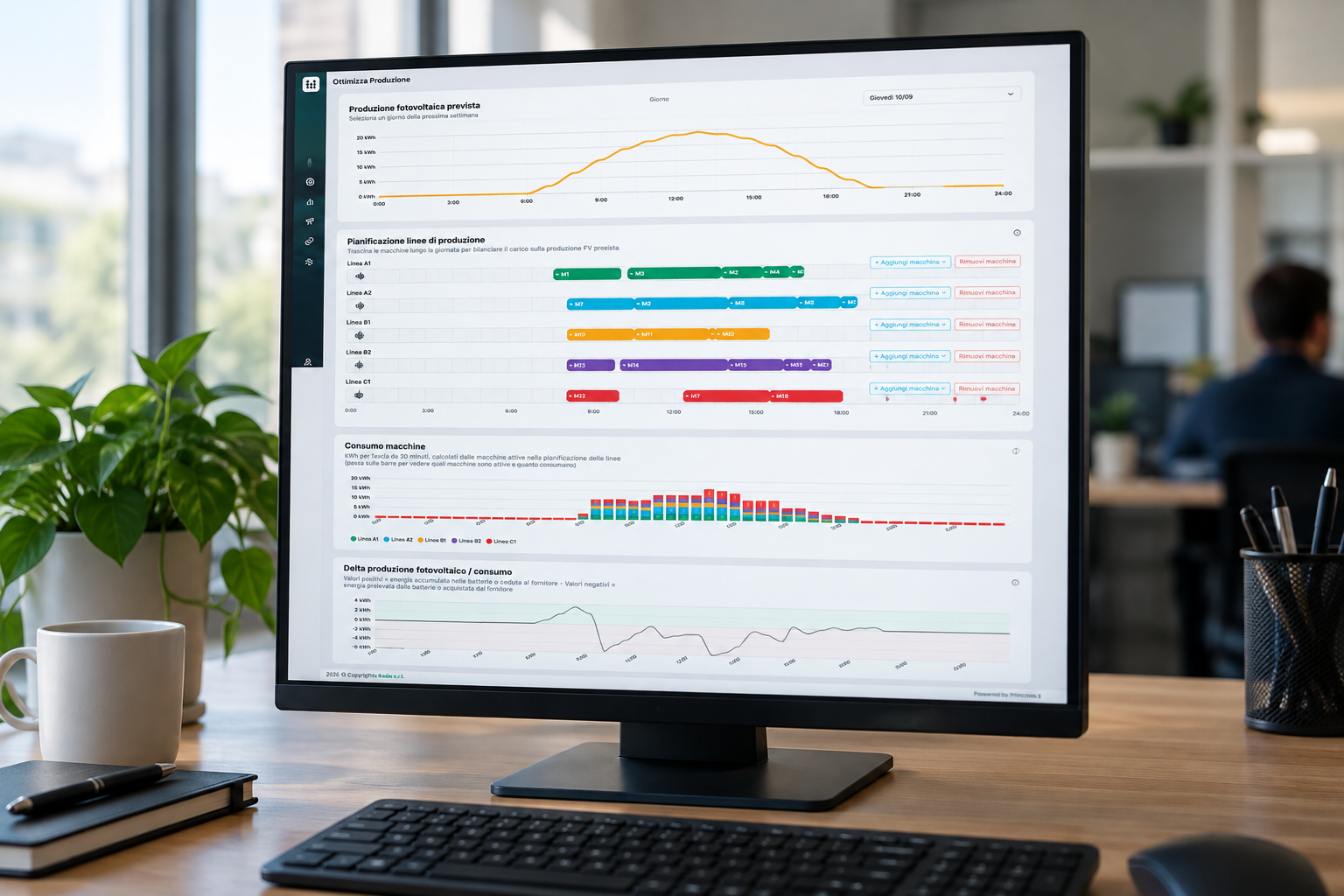
Starting from an integrated analysis of solar-energy generation and consumption linked to the production process, our optimisation algorithms build production schedules around the availability of on-site energy or the most cost-effective time bands. And for processes that cannot be interrupted, we optimise auxiliary energy-intensive loads: compressed air, refrigeration and HVAC.
What you get:
- Actual versus optimisable self-consumption for each machine
- Shift flexible loads into the solar-generation window
- PV system performance ratio
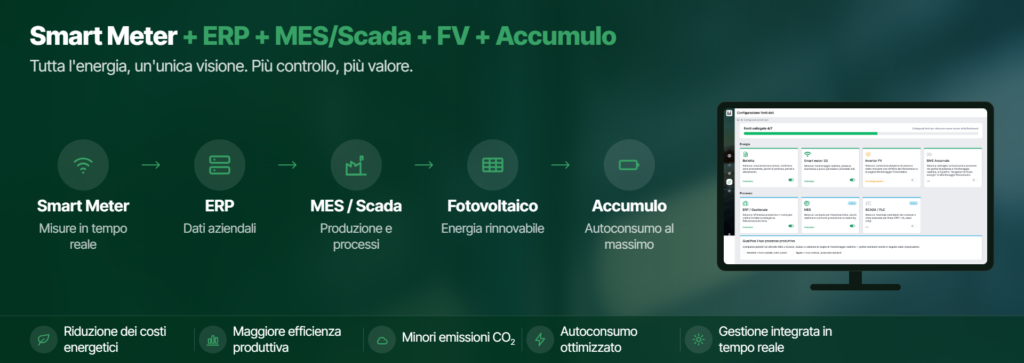
Orchestrate solar, battery and production
Coordinated optimisation: load shifting, battery charge/discharge cycles and contractual power-peak management. For processes that cannot be stopped, we manage stored energy to cover peak periods before supplier penalties apply, when on-site generation is not enough.
What you get:
- Coordinated optimisation: loads + PV + battery cycle
- Predictive peak shaving with verifiable savings
- Intelligent F1/F3 tariff arbitrage
- Daily energy calendar
- Optimal scheduling by machine and production line: battery + solar + active order constraints
Would you like a dedicated demo?
Contact us to arrange a meeting with our technical team, understand your company’s needs, and address any technical or functional questions.

