Two speeds, one bottleneck: what the data tell us about large manufacturing enterprises and SMEs
Two studies released just a few months apart — Rockwell Automation’s “State of Smart Manufacturing” report (11th edition, 1,560 decision-makers across 17 countries) and the Digital Innovation Observatory for SMEs from Politecnico di Milano (379 Italian SMEs) — capture two worlds advancing at profoundly different speeds toward the same destination: a manufacturing sector governed by data and artificial intelligence.
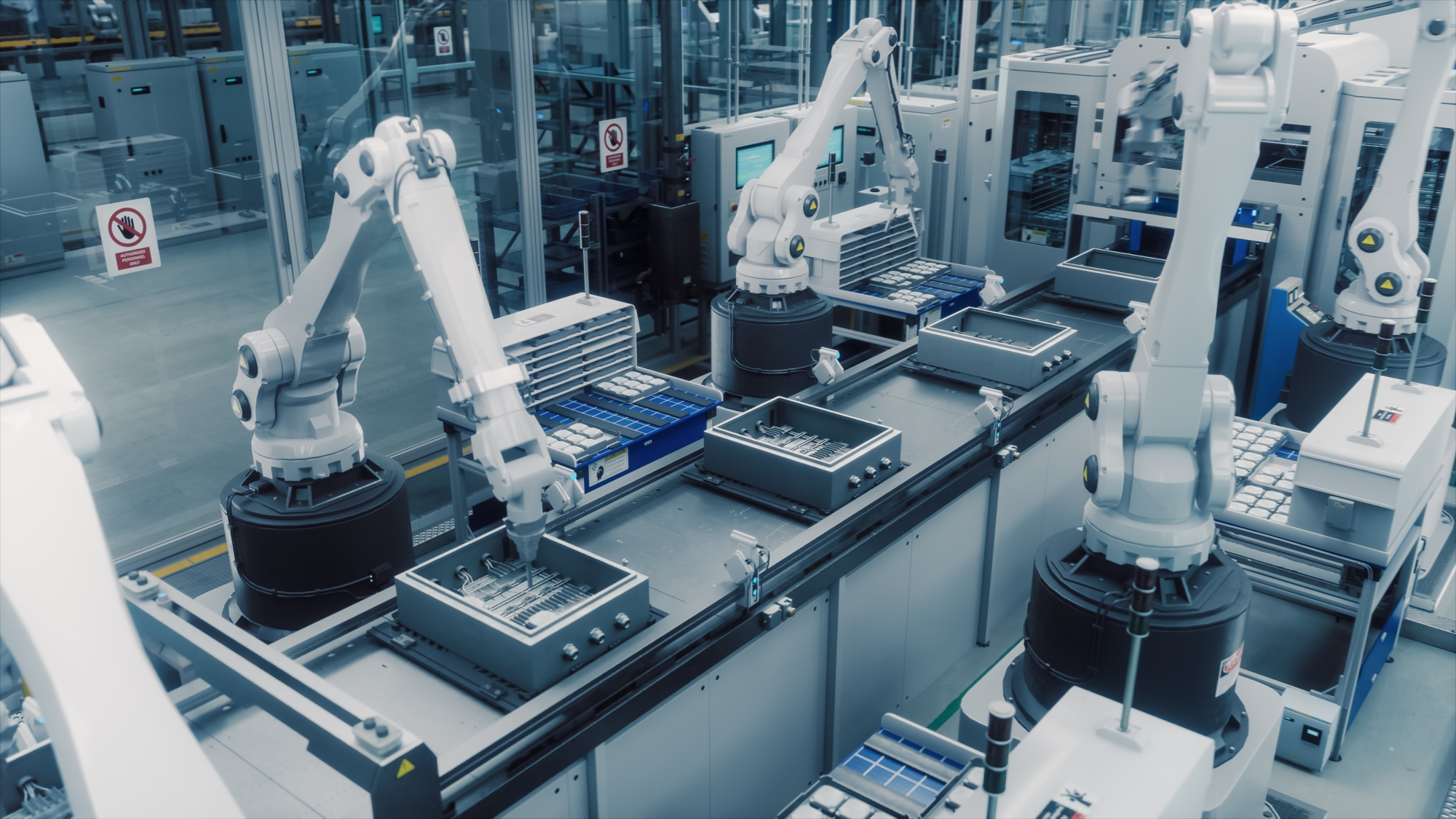
Large manufacturing companies are already in the execution phase. 90% of Rockwell’s respondents state that digital transformation is essential to remain competitive, and the most significant finding is that AI has “passed the tipping point”: 48% of manufacturers consider it the primary success factor, and today a third of quality control and production optimization operations are already supported directly on the shop floor by artificial intelligence technologies (with growth expected to reach 54% by 2030).
Looking ahead, 34% of respondents believe the industry will no longer face a single dominant threat, but rather a set of concurrent pressures tied to energy costs, labor, and cybersecurity.
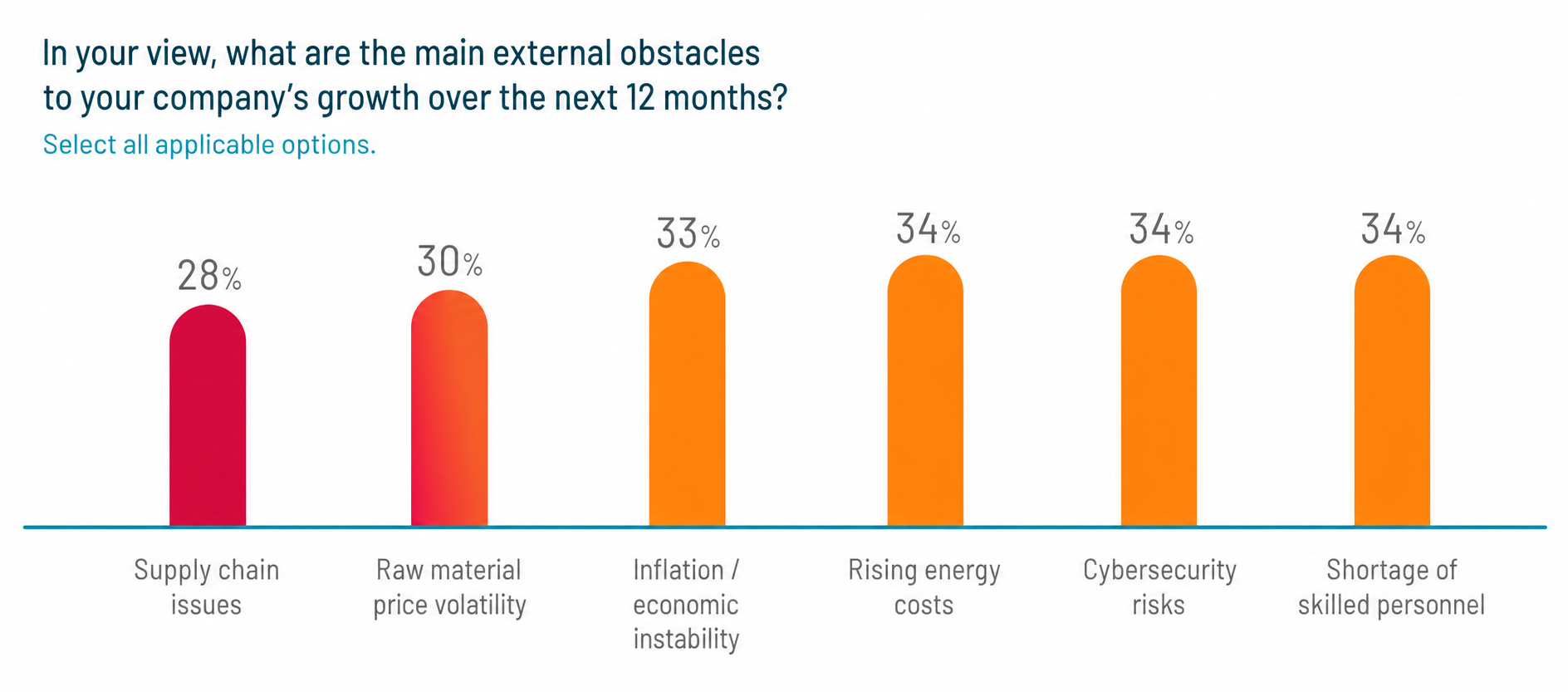
Growth obstacles in the next 12 months – “State of Smart Manufacturing” Report, Rockwell Automation
Italian SMEs, by contrast, are at a different stage — with different priorities. The PoliMi Observatory reveals a sharp polarization: 51% of SMEs are investing decisively in digital technology, but the remaining 49% take a cautious or absent approach, and 14% aren’t investing at all. Even more telling: 76% of Italian SMEs have neither invested nor plan to invest in artificial intelligence, and 91% remain on the sidelines of emerging technologies in general. As with large-scale industry, the main concerns aren’t technological but macroeconomic — the geopolitical landscape, energy costs, difficulty finding skilled personnel — while “the rapid and relentless technological disruption driven by artificial intelligence does not generate the same sense of urgency,” as the Observatory itself notes.
The risk, as the PoliMi report makes clear, is that this represents a problem that is “not merely contingent but strategic in nature”: the gap with larger competitors and foreign rivals threatens to become difficult to close — not because SMEs lack talent or market opportunity, but because the window of time to catch up is narrowing.
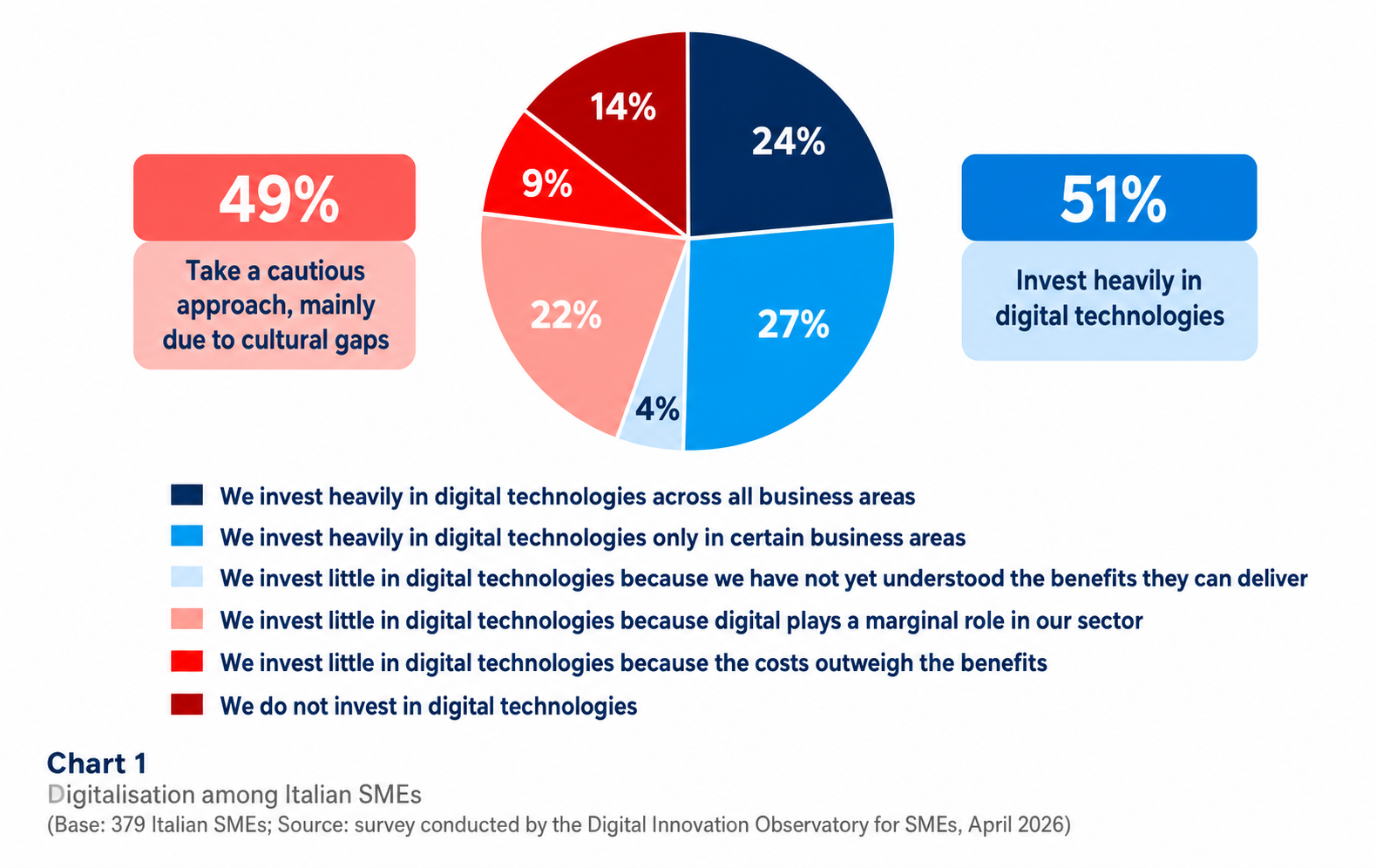
Digital orientation of Italian SMEs – Polimi Digital Innovation SME Report
The common thread, despite the different speeds
But if you look beyond the percentages, the two reports — while describing very different realities — converge on an identical underlying diagnosis: the real obstacle is never technology itself, but data.
Rockwell puts it in almost paradoxical terms: large manufacturers are collecting more and more data, yet only 43% of it is actually used effectively. The problem isn’t data availability, but consistent, large-scale operational management of it — disconnected, uncontextualized, unreliable data that gets lost between IT and OT systems that don’t communicate with each other.
PoliMi arrives at the same conclusion from a different starting point: SMEs suffer from a “lacking data-driven culture,” which translates into delayed adoption of solutions for collecting, monitoring, and structurally archiving company data — data that should serve as the input for any AI model, but that simply doesn’t yet exist in a usable form.
It’s the same bottleneck, observed at two different stages of the same chain. Large companies have too much data and fail to integrate it; SMEs have too little and fail to structure it. But the destination — a coherent, contextualized data infrastructure capable of powering decisions and AI models — is identical for everyone.
A look ahead
If data integration really is the bottleneck, then the game that will play out over the coming years won’t be between those who “have” AI and those who don’t — it will be between those who solve the underlying structural problem first. Large manufacturing companies have an advantage in scale and budget, but they’re discovering that AI, without a layer of “operational intelligence” — the ability to connect heterogeneous sources, contextualize them, and make them reliable — remains an investment that struggles to generate returns. Italian SMEs, for their part, have a less obvious but real advantage: starting from scratch, they don’t have to dismantle years of silos and technical debt, and they can design a native, integrated, AI-ready data architecture from day one — provided they stop treating digital transformation as a marginal cost item and start treating it as strategic infrastructure.
The real risk for SMEs isn’t so much falling behind on AI itself, but rather continuing to postpone building the data foundation that makes AI possible — because once it does become an actual urgency, the question will no longer be “which AI model should we adopt,” but “do we have data integrated enough to make it work?” And on that question, today, the gap between large manufacturers and Italian SMEs is measured in years, not months.
Sources:
- State of smart manufacturing (Rockwell Automation): https://www.rockwellautomation.com/en-gb/capabilities/digital-transformation/state-of-smart-manufacturing.html
- La trasformazione digitale nelle PMI italiane: il quadro aggiornato (Osservatori Digital Innovation Polimi) https://www.osservatori.net/report/innovazione-digitale-nelle-pmi/trasformazione-digitale-pmi-italiane-quadro-aggiornato/

