Computer Vision for Infrastructure Management: The Added Value of EBW Solutions
The Utilities sector has long been facing significant challenges, but thanks to the introduction of advanced data-based technologies such as Artificial Intelligence, Machine Learning, Deep Learning (DL), and Computer Vision, infrastructure management (Asset Management) is undergoing a crucial transformation. Let’s dive into this interview with Francesco Mete, CEO of EBWorld, to explore the challenges and new solutions that we can already implement for this sector.

The main challenges for the Utility sector involve the need to adopt an integrated approach that holistically considers the territory, the network, and the broader context to optimize planning and management. Additionally, complex administrative processes represent a significant obstacle, slowing down the construction and maintenance of networks and leading to increased costs that affect both operators and, indirectly, citizens. Another critical issue is the difficulty in finding skilled technicians and workers for field operations, a factor that continues to hinder the sector’s development.
With the entry into Kode’s shareholding, a company specializing in data science and AI, EBWorld aimed to integrate these technologies into its solutions and services to support the infrastructure lifecycle. We discuss this with Francesco Mete, CEO of EBW, who delves into the strategic role of computer vision in infrastructure asset management and the substantial benefits it offers to clients and stakeholders.
Often, when talking about AI, people think of abstract applications and less tangible scenarios. What benefits can Computer Vision bring, particularly in the operational aspects of this sector?
Answer:
One of the most pressing issues for companies managing infrastructures, particularly network infrastructures, is the lack of specialized labor. This includes operators, workers, and technicians tasked with performing high-risk, error-prone operations that are complex to complete within short timeframes. This shortage results in delays, increased costs, and often the inability to carry out routine and extraordinary management and maintenance activities for the infrastructures.
In this context, Computer Vision represents one of the most promising technologies for improving infrastructure management, enabling the detection of issues, monitoring the condition of structures, and preventing critical problems more quickly and accurately than traditional methods.
EBWorld has always stood out for its deep understanding of its clients’ processes. Applying computer vision to our solutions and services means leveraging technology to offer new solutions that address real and tangible problems, which unfortunately often hinder the growth of companies.
How does Kode contribute to strengthening EBW’s expertise?
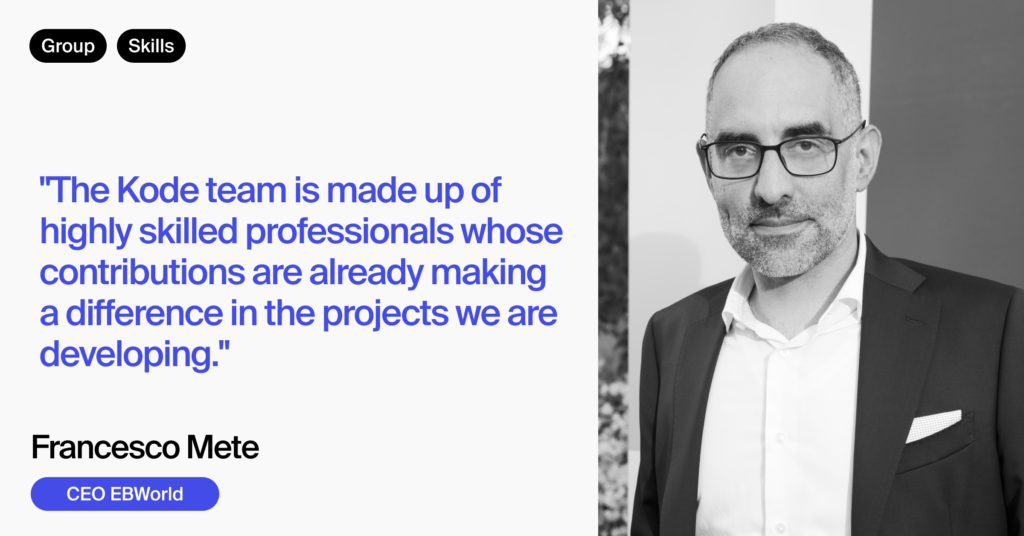
CEO: Kode brings us valuable know-how in the field of artificial intelligence. Thanks to them, we have access to new technologies that we can integrate into our systems. Moreover, this acquisition goes beyond technology and includes talent as well: Kode’s team consists of highly skilled professionals whose contributions are already making a difference in the projects we are developing. Together, we are building even more customized and innovative solutions for our clients.
Question 4: What is the added value of Computer Vision for EBW’s clients?
CEO: For our clients, the added value lies in the ability to make faster and more informed decisions. Thanks to Computer Vision, it’s possible to obtain detailed, real-time analyses of the condition of infrastructures, reducing response times. Another key aspect is cost reduction: fewer manual interventions, fewer errors, and better strategic planning result in significant savings. Finally, there’s the issue of safety: the technology allows us to identify potentially dangerous problems before they become emergencies. It may seem like a detail, but working in sectors like Telco and Utilities, which are highly strategic for the country, this integration makes us even more capable of supporting large-scale organizations.
Question 5: What are the main challenges in adopting Computer Vision, and how does EBW address them?
CEO: One of the main challenges is the quality and quantity of data: Computer Vision relies on large, well-structured datasets. For this reason, we are investing in building robust data infrastructures. Another challenge is integrating the technology into existing processes, which are often resistant to change. To overcome this, we work closely with our clients, offering training and support to ensure a gradual and successful adoption. Finally, there is the ethical and security aspect: we want to ensure that the use of technology meets the highest standards of privacy and data protection. In fact, utilities are facing cyberattacks, as often reported in the TopUtility reports, particularly affecting multiutilities and networked companies located in the central-northern part of the country.
Question 6: What is the future of infrastructure with the integration of AI and Computer Vision?
CEO: The future is extraordinarily promising. I envision smarter, more interconnected infrastructures that can “self-manage” thanks to advanced monitoring and analysis systems. Computer Vision, along with all data science technologies, will be the key to anticipating problems and optimizing resources in a sustainable way. It’s no coincidence that our company’s purpose speaks to the impact we aim to make—contributing to a society that is increasingly connected, secure, and sustainable.
