A little chat with: Alessio Sommovigo, Back-end developer and manager in charge of Chemoinformatics BU
Back-end development is of utmost importance in the creation of a software solution and can strongly differ depending on the field in which it is applied. Chemoinformatics is a very special field in which we are confronted with sector specialists and the complexity of their technical requests. Creating the right infrastructure, without ever limiting the needs of our customers, is not always easy. Today with Alessio we try to explore this aspect of Chemoinformatics
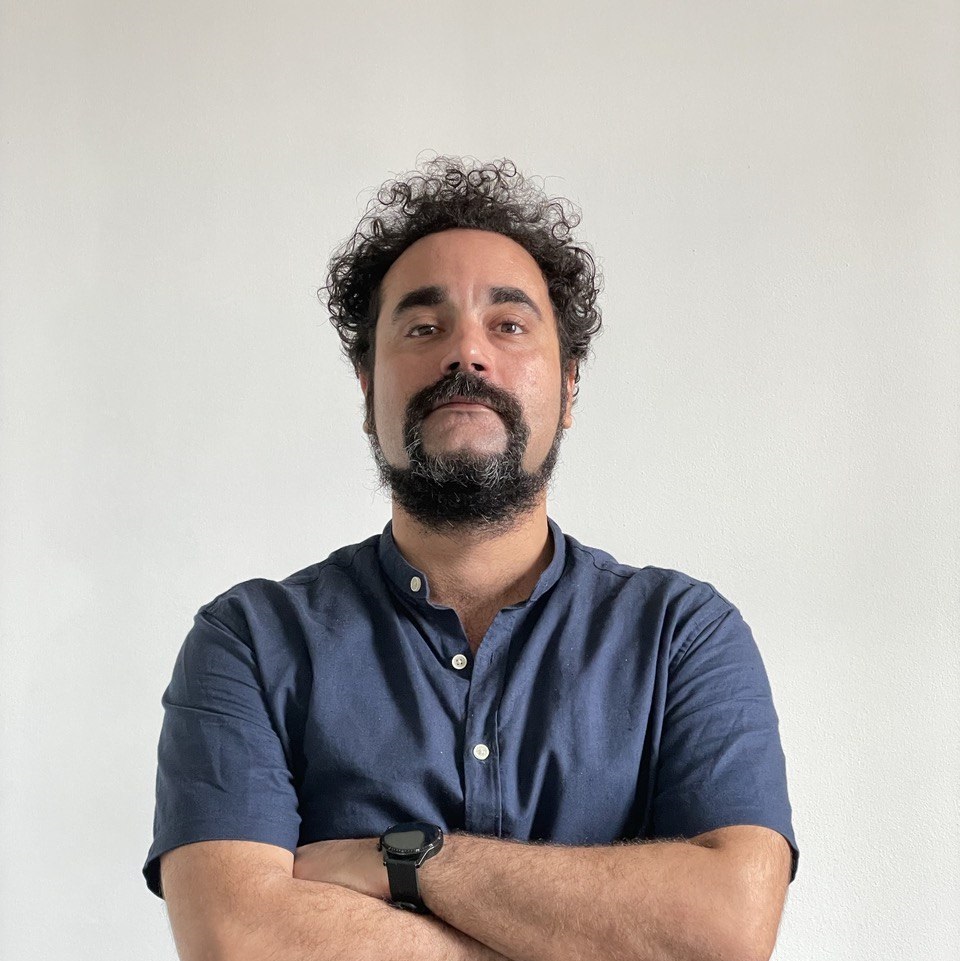
Alessio Sommovigo, Back-end developer and manager in charge of Chemoinformatics BU
Alessio, would you like to explain a little bit about what your work consists of in this very specific area of Data Science, Computational Chemistry, as well as in Chemoinformatics?
I develop Computational Chemistry and Chemoinformatics software solutions, implementing the algorithms and models designed and created by our computational chemists to make them usable by our customers, according to their technical requirements.
Sometimes it is a matter of integrating these Chemoinformatics solutions into existing architectures or frameworks; sometimes it is a matter of making them stand-alone software by providing them with a graphical or command-line interface, working closely with those in charge of front-end development.
Can you give us some examples of stand-alone software you’ve developed?
Most of the stand-alone software we develop is in the regulatory field. These are requests from companies whose need is to understand whether the new molecule being studied for a new product (be it in the pharmacological, food or biotechnological fields) falls within the eco-toxicological parameters required to be put on the market.
Given a molecular structure as input, these systems are able to search for all the information related to it, within all databases supporting the main EU regulations (REACH, ANNEX VI, SIN, etc.).
The developed solution extracts and cross-references the characteristics that allow to understand if and how much the compound complies with regulatory limits.
What is the path that led you to become interested in Computational Chemistry?
I do not have a background as a computational chemist. A degree in Biomedical Engineering gave me an initial foundation in computer skills and a certain aptitude for critical thinking: as an engineer, I acquired the forma mentis to analyse problems rationally and to immediately see both the pros and cons of each solution.
With experience and due to work requirements, I delved into various aspects of software development. I started out working as an IT systems engineer in a major paper industry, an experience that left me with a certain focus on the architectural aspect of a software solution.
I think that varied skills and a solution-oriented approach are helpful in the world of software development, but in Chemoinformatics this is not enough: on top of all this, I had to deepen my domain knowledge and keep up to date with the latest scientific research.
This is precisely why I bacem so passionate about this subject.
Getting back to software development: what peculiarities are there in Computational Chemistry?
As I said, computational chemistry is a field that requires deep domain knowledge.
Our customers are not only interested in how the solutions we propose work from a technical point of view, but they also want to be aware of the algorithmic and theoretical implementations behind them.
This is perhaps the main aspect that makes it different to build Artificial Intelligence solutions in this particular domain: it is not enough to know the specific technical requirements of projects.
This is why, beyond my personal experience in this field, I am pleased to be able to count on the top-level skills of the specialists we have in our team.
Let’s talk about teams and the integration of skills: is this an important aspect in your industry? What working methods do you apply so that everyone can express themselves to the fullest?
It is obvious that having a multidisciplinary team has the advantage of being able to draw on the contribution and specific expertise of each one.
Since we are dealing with researchers, university professors and in general people with a high level of specialisation, we must be able to deal with them competently and accurately at all levels.
A cohesive team in which the different skills complement each other is therefore essential.
The working method and tools we have chosen to use are designed to ensure that everyone’s contribution is optimal and never redundant, avoiding repetitive work that is often burdensome.
This allows us to work in a modular manner, reducing development, updating and maintenance time.
This characterises the whole Kode approach: the creation of tools and processes that save time on everything that can be standardised, in order to concentrate our efforts on what needs to be custom developed. After all, this is the thinking that drove all of Kode’s back-end developers (myself included) to jointly develop a framework called Princess that makes development tools available to data scientists, simplifying and optimising integrations.
In your role as Chemoinformatics BU manager, what new challenges have you faced?
In this new role, I find myself dealing with two very different aspects of our work, but I must admit that the co-presence of managerial and technical roles is a great added value: now more than before, I am able to understand the customer’s needs even outside the perimeter of the project on which we collaborate, and therefore to propose appropriate solutions on the business side as well.
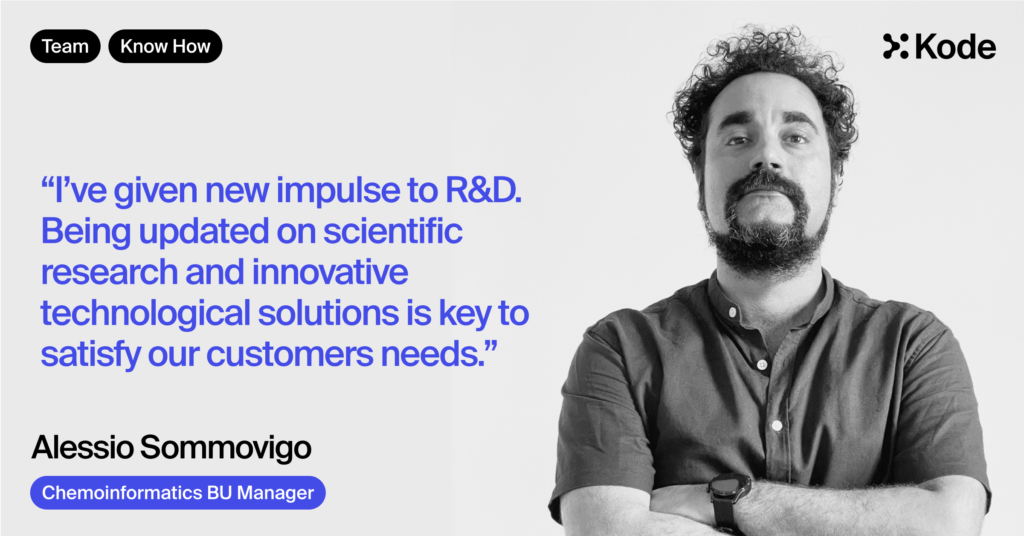
Since I have been in charge of the BU, I have chosen to give a new impulse to the research and development side, in order to better respond to our customers’ needs, while keeping us updated about the latest scientific research and the most innovative technological solutions
This approach allows us to fill those gaps that are present in existing solutions
Years after the release of the Vega Toolkit (application of multiple QSAR models in the field of ecotoxicology), we are developing an entire suite of products that can accompany computational chemists throughout the QSAR modelling process. We have already come out with the first product in this suite: FAST (Features Analysis and Selection Tool), an out-of-the-box tool to effectively solve the Features Selection problem.
The other solutions in the suite are in development and will solve key aspects of QSAR modelling.
There is great excitement and I am very proud of it.
