A little chat with: Ilaria Ceppa, Data Scientist, in Kode since 2014
The job of Data Scientist is increasingly popular and yet it is still a mystery to many. Despite the fact that there are now many dedicated training paths and that news everywhere discuss a lot about data and Artificial Intelligence, many still miss the concreteness of this job, that should never forget the importance of clear understandable insights. We ask our Data Scientist Ilaria Ceppa for help.
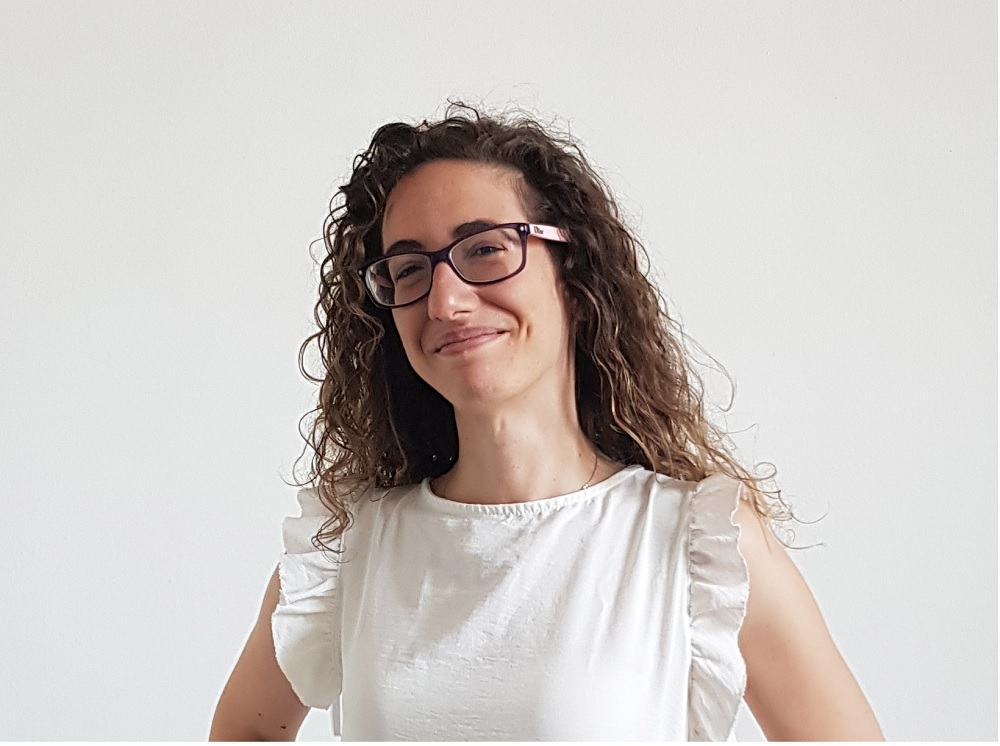
Ilaria Ceppa, Data Scientist
What does your work as a data scientist consist of?
Mainly my work is about finding solutions to concrete problems. It sounds very general but in fact Data Science applies to very different fields and with projects that have a wide variety of objectives. The only common aspect is the starting point of each project: namely, the intention to exploit the knowledge potential that the Big Data available in almost every company may unlock (despite their chaos).
The first step in my work is always study-based: first I have to understand the client’s needs, I have to understand (where possible) what data they have, and then reason out the ideal solution. I never work on my own, but I always prefer to start with a self-study phase, so that, when I exchange with my colleagues, I have not only knowledge of the facts and solutions available in the scientific literature, but I’m also ready to bring some proposals.
It is at that point, for me, that the integration of different expertise becomes an important key to find an optimal solution to our client’s problem
When we talk about Data Science we immediately think at algorithms, codes, etcetera. Doesn’t the work consist of that?
Yes, it does. But we rarely work on codes right away. First we think about the way(s) we could solve the problem we are facing. Indeed, when we have a dataset’s sample, it is easier to think about the solution to develop and, at the same time, test its feasibility and effectiveness. But it is pretty rare as a situation. That’s too bad, because often when we get to the integration phase, we find that what the data allows you to do does not always match what we expected. Therefore, our work requires great readiness and adaptability to reality.
This means not only adapting the hypothesised solutions to the system used in the company or to unexpected characteristics of the data really available in the company. It also means evolving classic Machine Learning tools, such as a PCA, to make its indicators speak to the customer’s team and its needs. By customer’s team I mean engineers, company managers or plant managers, who have completely different references one from the other and completely different needs. An integral part of Data Science is to make analysis’ insights real information, enabling operational intervention on, for example, a machine during a production process
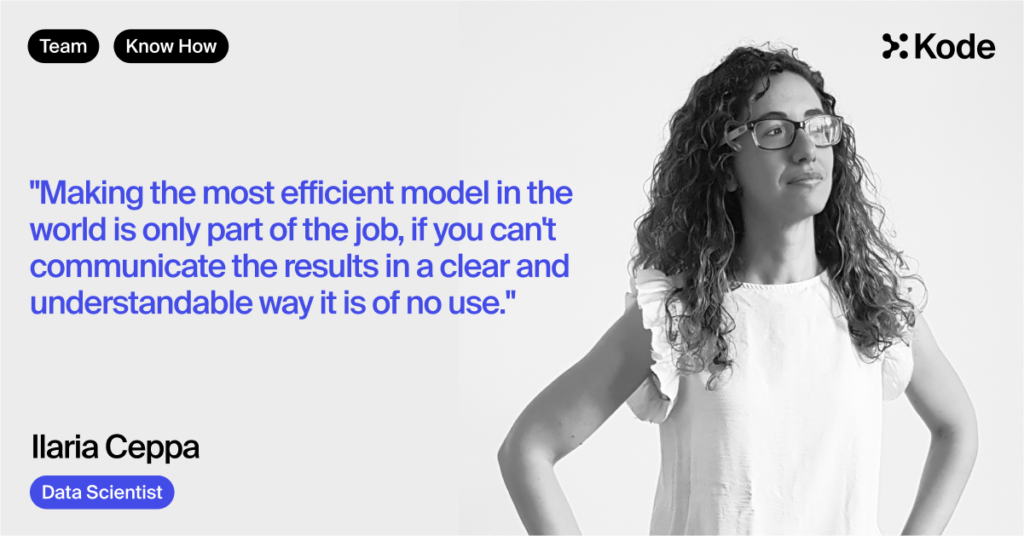
You can make the most beautiful and complex Artificial Intelligence model in the world, but if no one understands it, it’s of no use. In my opinion, making data science useful in real life is an integral part of it: it’s not enough to have the data available; it’s not enough to have analysis either, if you don’t understand how to extract meaningful insights or interpret it to make decisions. This step, too, is data science.
Let’s talk about education, by what route did you get here?
I chose this direction since my studies: I liked Data Analysis, I wanted to do it. Hence I enrolled in computer science, but unfortunately there wasn’t yet any dedicated training path dedicated to data science (neither in the bachelor’s degree nor in the master’s degree). There were, here and there, a few courses approaching the subject: as an example, I took a class in Data Mining, one in NLP, Robotics… I also attended a course in Artificial Intelligence which, although at the very beginning, introduced me to the basic concepts and gave me the desire to delve into the more advanced techniques that I use today.
In my Master’s degree, I embarked on the Machine Learning course (which was called “Apprendimento automatico” in Italian) and since then, I have studied and deepened this subject.
At the end of the day, that’s what I still do: a fundamental part of my job is to keep studying because, although I have a pragmatic personality (and I look for insights when problems require me to do it), every day a new maybe-useful thing comes out. In the end, curiosity and my longing for the best performing solution is the greatest drive every day.
